Wednesday, January 25, 2017

The Adventure Begins

 After almost a year and a half of working on the boat, we finally taking off for a somewhat extended cruise.  For real cruising folks, 4 months is nothing but for us, it's awesome!  This will give us a chance to enjoy the fruits of our labor and learn some of the systems we have on board but never had the time to learn.  Getting away from the dock was a bit of an adventure with glitches galore.  First, my phone chose to conk out on Saturday.  It was one update too many for the 4 year old platform.  Thanks to the super staff at our local T-Mobile, who were having their own technical issues, I have another phone.  Due to the old one being unable or unwilling to reboot, I lost some things and had to spend a lot of time downloading all the apps we need like radar, weather, etc.  And all the things I want like pictures, Instagram, etc.  Anyway, I will have a project for a few days.  Then as David was doing one more engine inspection yesterday, he found a cracked bracket holding our alternator in place.  In case your not a mechanic, that could have caused a lot of bad things to happen and that sort of thing always happens at the worst possible time.  Thanks to Jack's Marine, we had a new bracket made quickly and we finally left the dock about 2.  There wasn't much wind so we gave the engine a good workout.  We were not overly ambitious so we made Hogtown Bayou by sunset and that was enough.  We enjoyed soup for supper and turned in early.  Today's goal is Smack Bayou in St. Andrew's Bay where we'll wait out some rain.  It looks pretty good for a gulf crossing on Friday to somewhere on the peninsula.  I'll keep you posted as wifi is available.
Making sure the water tanks are full

All ship shape and ready to go


Departing the Fort Walton Yacht Club


Rebuilt forward companionway.
First sunset
Thanks to Sue, we'll always find our way home. 
This is our street address in our "other" life.

Friday, January 20, 2017

Solent Sail

While a ketch is a great design it does not "point" well.  That means it doesn't sail towards the direction the wind is coming from well at all.  No boat can sail directly into the wind but some, due to hull shape and sail plan do better than other.  Ours was in the top of ketch designs for going to windward but that only means it is not a total dog.  We wanted a sail that would allow us to sail closer to the wind and also give us a reduced sail area for those really windy days that are common in the tropics.  Adding an extra sail to the inventory has been in the works but since it is not a standard item, there was some design work involved.  We picked a lot of brains on what had worked and didn't work on other 424s.  In talking with riggers and our sailmaker, we came up with a good solution.  The beauty of the solent rig is that it is moveable and the stay (thick metal rope) is not permanently installed on the foredeck waiting to attack some unsuspecting fool in the middle of the night while they inspect the anchor.  The high tension lever lives on a shelf below and the stay ties off to the side deck out of the way.  Before the solent rig, the very best we could do to windward was about 60 degrees.  As you can see in the picture that is now improved.  We also had reef points put in the sail so it becomes good for really heavy wind.


This beefy piece of metal is installed below decks to support the forces of the sail when full.
The special lever attaches to the deck fitting and can be stowed below when the sail isn't in use.

The solent is close to the furled jib.  It is almost the same dynamics as the jib but smaller in area.


The wind indicator shows how close to the wind we can get with the new sail.


Monday, January 16, 2017

Miscellania

This brings us up to a week before we hope to depart the dock.  Our goal is January 23 as I work until late the previous night.  Even if we only make it 10 miles we'll have done the hardest part of cruising, shoving off.  We used to say our boat was a 100 footer since she looked good from a 100 feet away.  We have worked hard but we now have a 10 footer!  I hope you follow us along our trip to the Abacos Islands in the Bahamas.
We don't leave God behind when we cruise.  If anything, we need Him more than ever!

This is a sail bag designed to withstand the sun's rays while it's on deck.  This holds our Solent sail.  That was an engineering feat in itself.  More on it later.

Printer

One of the things that will make living aboard easier is looking at GRIB files on paper copies as well as printing out forms we'll need as we travel from port to port so I installed a printer.  I have networked the computer, tablet and printer all together and we can stream movies.  Almost like home. 


Groove all installed.  Pulls in a signal form a fair distance.
Routing for 12 Volt inverter cord

Spot designed by previous owner for printer.  I found one to fit it but I had to move one of the side stops 1/2 inch.

New router and inverter.  The printer and router power cords will be connected to these
Printer installed.

Dorade Boxes 2

The weather cooperated so the boxes are now installed and the headliner is back in place so the interior looks so much better.  David is touching up the nonskid on the deck to cover the nicks created by all the work we did in painting the hull and installing the boxes.


As with any boat project, we have to special design everything including where the backing plates must go.

No so pretty on the inside but this is how they look inside.  Any water will be kept out by the standing pipe and drain out through side holes.

The install process.

From the inside to the outside.
Original Dorade

Trim ring to cover the hole in the headliner with screen to keep critters out.
Installed and cleaning up.

Saturday, January 14, 2017

Dorade boxes-Phase 1

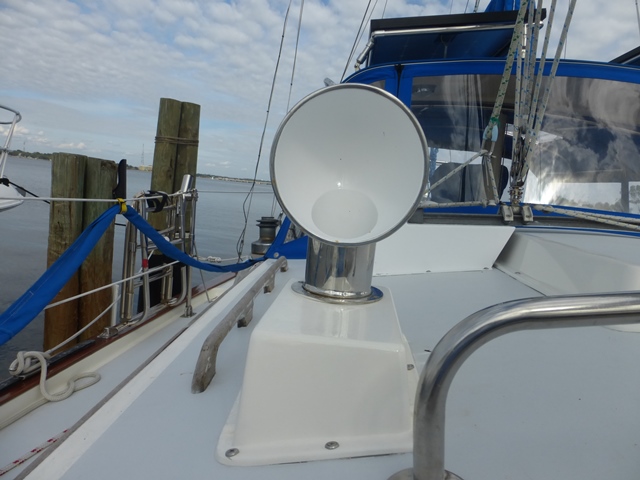
One of the things I really wanted was more ventilation on the boat.  We have a real problem in some areas with mold and it is gross and unhealthy.  One method is to always have a fan or AC running but that is a real power guzzler and not practical at anchor.  Another way is passive ventilation using dorade boxes.  These ingenious boxes allow air in and keep water out. When it's raining and you can't open your ports or hatches, this matters.  Most higher end sailboats used to come equipped with them and we had them on Sanctuary. They have fallen out of favor as more boaters choose the floating condo lifestyle and spend more of their time tied to a dock or bring along noisy, gas-guzzling generators.  Since neither of those options fit our dream of the cruising lifestyle, we're going with dorades. We have two now but one is for the anchor locker and the other is in the head.  This gives no good airflow for most of the cabin. We found two old boxes in a marine resale shop and fixed them up.  David made new lids as the original ones were ugly beyond repair.  Of course, this involves cutting more holes in our pretty deck but no mold and a cooler interior in the heat will be nice.  We have plugs for them during the winter so cold air doesn't gush in.  This project is currently underway so you'll have to wait a few days to see the end result.
Working on cleaning up the old boxes

8 coats of varnish on the boxes and cockpit table.  Nice work space on the patio at home
More headliner down and checking for spacing
More holes in the deck

Other odds and ends

My end of the cruising bargain is logistics.  I provision, figure out the entertainment end of things and make the computer work.  It may be his boat but it is my home and I try to make things as comfortable and convenient as possible.  I bought an upgraded model of my previous WiFi extender and after some initial hiccups, it is now working.  I've also upgraded the router so our Roku stick, computer and tablet all place nice.  Next week I'll add the printer I bought and get it all networked in so he can have a hard copy of his weather maps. I've also added some 12 volt inverters to save having to be either plugged into a dock or running our whole boat inverter just to pull in grib files or quickly check email.  I also activated our hotspot so as long as we have a cell signal or an nearby WiFi signal, we'll be connected.  Near yacht clubs and most spots in the US there shouldn't be any limitation other than power but the Bahamas will be another story.
Grand baby calendar


Stick up LED lights

Installing WiFi extender

4 months of staples
Making sure glass has a chance of surviving

Life raft

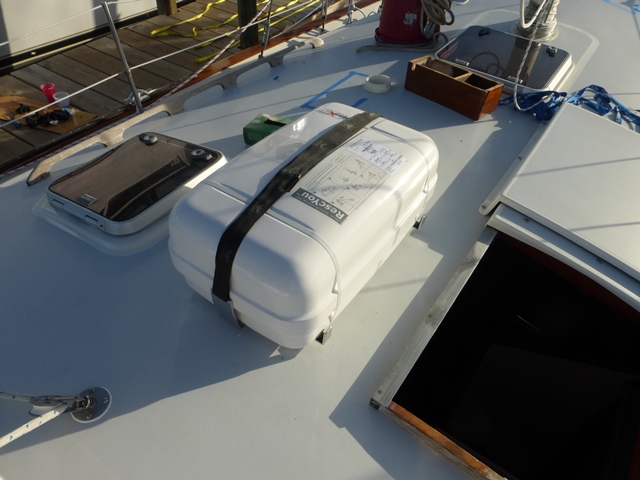
We aren't expecting to sink but we felt it would be prudent to prepare for disaster.  We have personal locator beacons, one of which will send an AIS signal, an EPIRB. a hydro-statically activated life vests and now a new inflating life raft.  It is tough cutting holes in your gorgeous new deck but it had to been done.  We hope we never need any of the gadgets but will sleep better in the blue water knowing we have them.
First you have to take down the headliner and make sure where you plan to drill holes doesn't interfere with anything vital like wiring.
Marking and drilling the holes.

His lab, my galley.
The holes aren't simply drilled.  The core must be routed out and replaced with hardened epoxy to prevent and water seeping into the core and causing rot.  You then drill through the epoxy for through-bolting your mounting hardware.
Bracket in place to hold the hard valise of the life raft.
Another project off the list.

Cockpit enclosure

One of our must-haves when cruising is a cockpit enclosure.  Crossing the open water on a cold night with water coming at you is a truly miserable experience.  We learned on Sanctuary that protection from wind and water makes you comfortable and more alert and way happier!  We went through a few iterations on Sanctuary so we had a good idea of exactly what we wanted on Blue Moon.  We had a full enclosure when we bought her but it wasn't adequately high and had some bad leak points.  Tim, Adam and the crew at Canvas Specialties spent a lot of time working with us, taking our notes, making their own and then custom fitting each piece to give us a wonderful and snug cockpit.  With their suggestion, we have a high-tech front window that is literally as clear as glass. Adam designed a way to fold it back and secure it when we want the ventilation.  Our friend, Suz, dubbed the first one our "tea room" and that is how we will always think of it, Suz's tea room.
Raised hard dodger
New bimini frame
Enclosure from front

Enclosure from side

Inside our cozy "tea room"

High tech windscreen


Taking her home

The process for taking Blue Moon out of the water was tricky.  We were at the upper limit of the travel lift's capacity and we had to remove the forestay to make it work.  That involved loosing all the side stays and using our solent stay to keep the mast in place.  Lots of tedious trial and error but it worked and then it was all done in reverse once we got her back in the water.  Once we had her home it was time to start the next phase.
Putting our shiny baby back in the water
Very happy man trying out the new prop.

Home sweet home!